

Flat and wide beats the quick buck: the customer base that survives a bad day
This is the second post in a series of five, excerpted from lessons in business by our founder, Peter Gradwell. They are taken from a YouTube interview he did in the "UK Business Forums" podcast series.
Early in the Gradwell.com days — around 2000 — there was a moment when speculative domain registrations were, essentially, printing money. Sensible people were buying every product-shaped name they could think of in the hope of flipping it later. I was watching that wave from the outside, and part of me was tempted to ride it harder. A lot of people did, and many of them got hammered when trademark holders started suing to recover their names and chargebacks came flooding in.
I stayed out of those particular waters. Not because I was clever — because I was nervous.
"I've always liked the business model which is flat and wide — many many thousands of customers spending a little bit of money. So that if something goes wrong, and you piss a few off, the business is still safe."
A lot of early-stage founders underestimate how important that sentence is. It's not a quote about marketing strategy; it's a quote about risk management. When your revenue depends on ten whales paying you £50,000 a year, losing one whale is a 10% hit. When it depends on five thousand small customers paying you £10 a month, losing ten customers is barely a rounding error — you earn more than that every week just by existing.
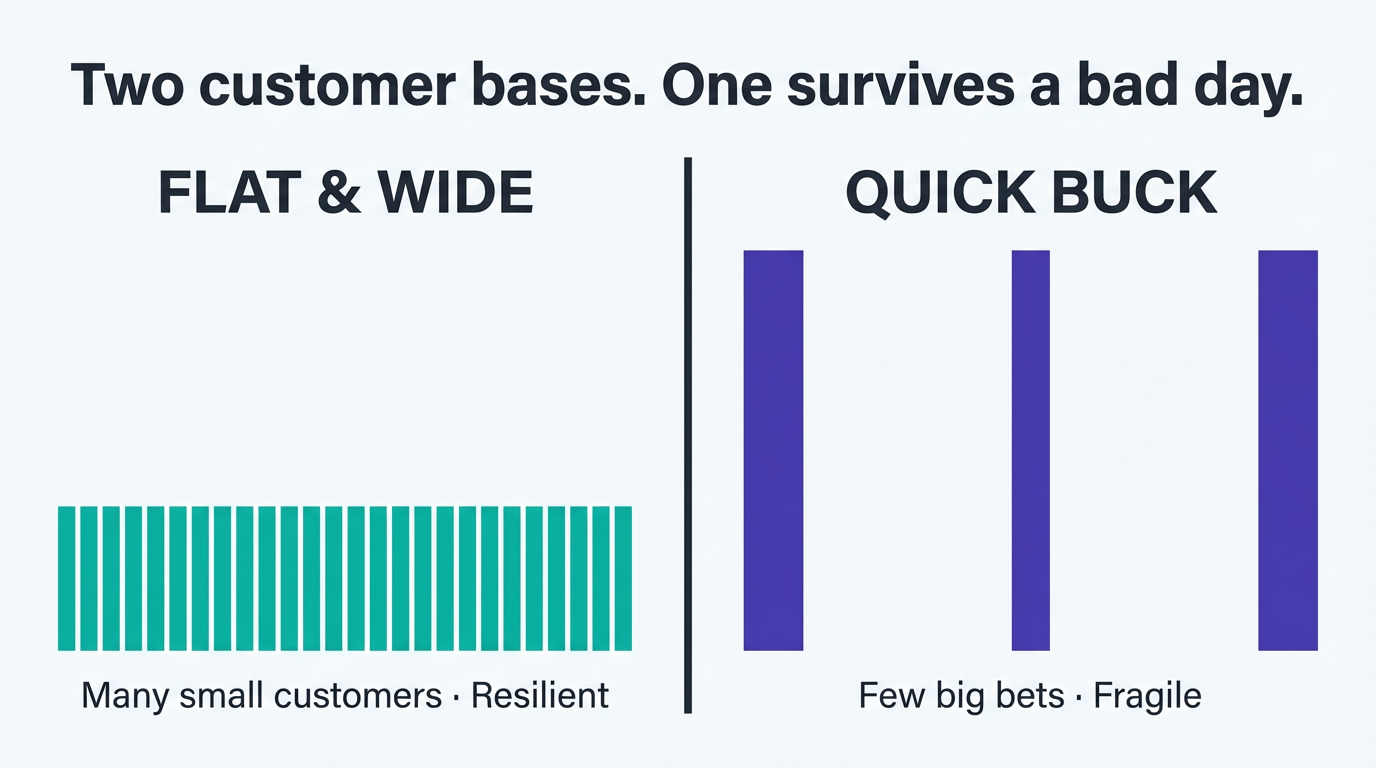
The quick buck always looks better on the spreadsheet. The margin is higher. The sales cycle is shorter — or at least more satisfying. The problem is that spreadsheets don't model the variance. Your revenue might look identical to a flat-and-wide business on paper, but one bad news cycle, one regulatory change, one disgruntled customer with a lawyer, and the whole thing wobbles.
I saw this repeatedly through the 2000s. Premium-rate phone numbers, for instance, were offered to us all the time when we ran Gradwell's voice business. The margin was genuinely fantastic. But they came with fraud risk, chargeback risk, regulatory scrutiny, and customers who felt burned when they couldn't make their numbers work. We passed. We lost margin. We kept our sleep.
Why "flat and wide" actually works
It comes down to three under-priced effects:
- Churn smooths out. If you have 5,000 customers and 2% of them leave every month, that's 100 people. Painful, but 100 people don't tip the business over. If you have 20 enterprise customers and one of them leaves, that's 5% of your revenue gone in a single email.
- Big customers demand big service. The £50,000 customer wants custom integration, dedicated support, quarterly reviews, and a C-level on call. The £10/month customer wants the product to work and the invoice to be right. One of those is a business; the other is a job.
- Product decisions stay honest. When your top 10 customers represent 50% of revenue, they steer the product — whether you want them to or not. When your top 100 represent 5%, you can build what's right for the whole market.
When the quick buck is actually fine
None of this is an argument against ever taking a high-margin, high-risk deal. It's an argument against letting those deals become the business. Treat them the way a casino treats individual high rollers: nice when they come in, but the house edge is built on the millions of small bets underneath.
Today at IQ Mobile, the principle still runs. We sell SIM cards to small businesses one or two or ten at a time. The tickets are small. The volumes add up. And the business is boringly, wonderfully resilient — because if any single customer has a bad day, the business doesn't.
Flat and wide isn't glamorous. That's the point. Nobody ever went to bed worried about losing a customer they didn't know they had.