

The two-year cost of a bad senior hire (and how to fail faster)
This is the fourth post in a series of five, excerpted from lessons in business by our founder, Peter Gradwell. They are taken from a YouTube interview he did in the "UK Business Forums" podcast series.
Building a team is the hardest thing about building a company. That's my unqualified opinion after twenty-two years of doing it. Harder than product, harder than cash flow, harder than sales. And the most painful sub-problem inside team-building is hiring senior people from outside.
Gradwell grew organically for a long time. People came in junior and grew up through the company; culture was whatever we'd been doing on the Tuesday they joined. Then, as we scaled through a venture round, we wanted to put growth on steroids. That meant hiring experienced operators from outside — a commercial director here, a CTO there, a sales leader brought in to run the sales team. People with a playbook.
"It takes you six months to find them, a year to figure out whether they're good, another six months to replace them. You've lost two years."
That sentence is the one I wish someone had stapled to my forehead in 2007.
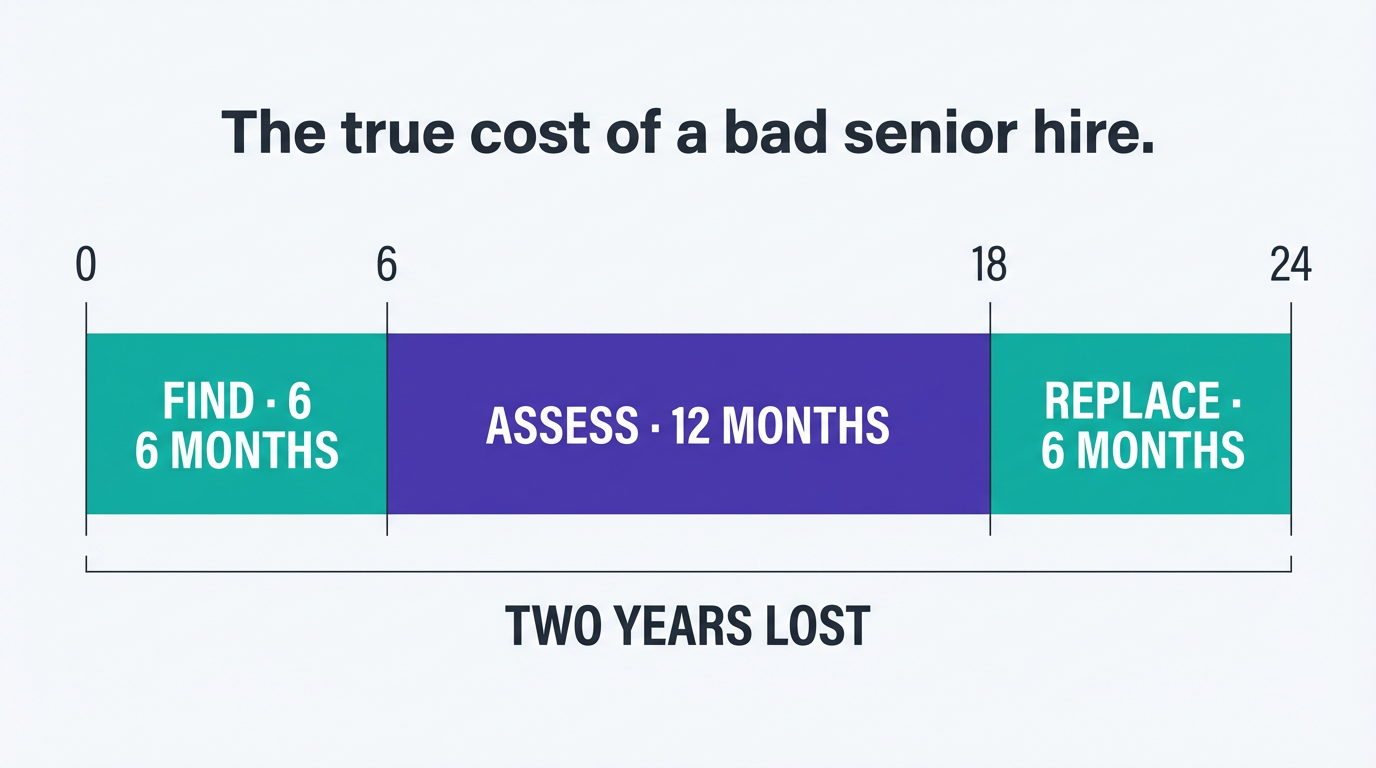
The maths is brutal. Six months to find someone you're excited about. Twelve months to figure out whether they're excellent or merely plausible. Six months to swap them out, if the answer is "merely plausible". That's two years of founder time, two years of the team waiting for the seat to be filled properly, and two years of lost compounding on the revenue line.
Why the playbook usually doesn't transplant
Here's what took me several hires to understand. The reason senior people are expensive is that they bring a playbook. The reason the playbook doesn't always work is that it was written in a different company. So there's an inevitable period where either your company bends to fit their playbook, or their playbook bends to fit your company — and that re-engineering is where most of the pain lives.
A sales leader who's built enterprise teams won't reliably run a retail-tickets-low-ACV business. Their instincts are wrong — not in a bad-person way; in a pattern-matching way. They want to hire five BDRs and run a pipeline review every Monday. Your business needs marketing-driven self-serve volume. The misfit isn't obvious for six months. By the time it is, you're a year deep.
Three things that shorten the cycle
I didn't crack this perfectly. Nobody does. But if I were starting again:
- Hire for the shape of your business, not the shape of the CV. If you sell many small things, hire people who've sold many small things. Ex-enterprise salespeople cost twice as much and struggle to believe a £10 customer matters. The reverse is also true.
- Define "working out" in writing on day one. Not OKRs. Specific, uncomfortable answers to the question: "what would I see by month six that tells me this is working?" Write it down before you've formed an emotional bond with the hire.
- Fail fast, publicly, kindly. If by month nine the answer is "I'm not sure," the answer is usually "no." Waiting another six months for the data to be undeniable costs the business more than it costs you to have the difficult conversation now.
The one that kept me up
The hardest firing I ever did was a genuinely good sales-and-marketing director who had all the right instincts and was moving at a third of the speed the board needed. I agreed with her direction. She was doing real work. It wasn't enough, and the investors could see it, and I hesitated. Hesitating cost us another six months and eventually cost her the job anyway. If I'd had the two-years framing in my head then, I'd have made the call sooner, and everyone — her included — would have been better off for it.
Senior hiring is inevitably imperfect. Imperfect hires that you correct quickly are a cost of doing business. Imperfect hires that you hold onto because you can't quite admit you got it wrong — those are the ones that eat the company.